Pillar
The best AI tools for medical school in 2026, ranked by what they're actually good at
Updated 1 June 2026 · 12 min read
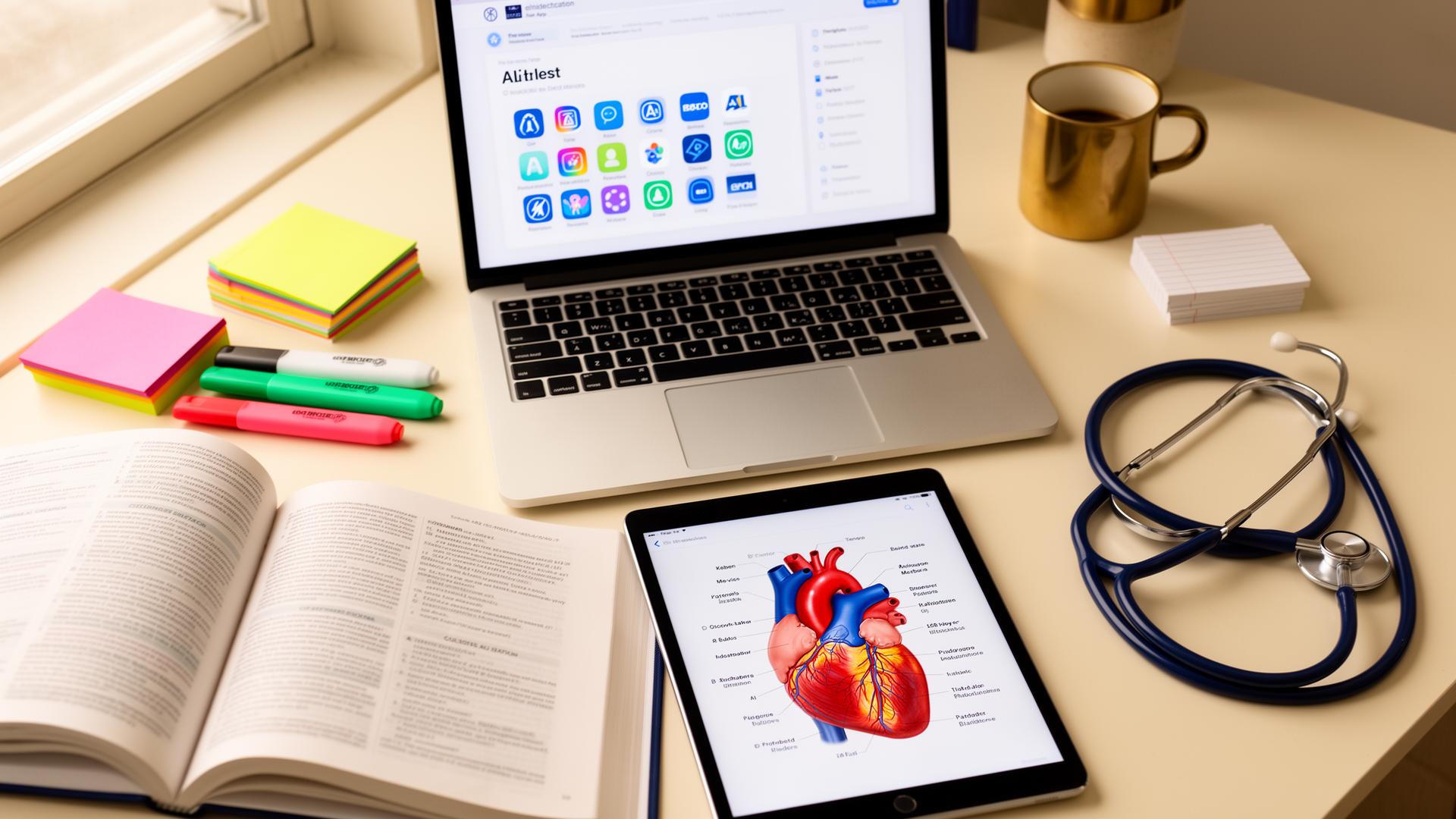
The best AI tools for medical school in 2026 aren't a single app — they're a stack of five free tools that, together, replace about £400 a year of paid study subscriptions. This guide ranks them by job, not by brand: explanations, lecture material, flashcards, diagrams, citations, slides and OSCE practice. Each entry lists the current price, the honest trade-off, and the alternative if it doesn't fit how you study.
How to pick AI tools for medical school in 2026
Every 'best AI for med school' list ranks the same ten apps in roughly the same order, usually whichever one is paying for the affiliate link. The better question is: what are you actually doing this evening? You have a finite number of study jobs in medical school — understanding, memorising, visualising, presenting, evidence-finding, OSCE practice — and each one has a clear winner in 2026. Pick the right tool per job and your monthly AI spend is zero. Pick the wrong tool and you spend £30 a month on a wrapper around GPT-4.
The other filter that matters is failure mode. A model that gets a Krebs cycle explanation slightly wrong is annoying. A model that invents a branch of the brachial plexus, then quotes a fake paper to back it up, can land in your final exam answer. Below, we mark which tools are safe to trust at face value and which need a second source every time. This is the single most useful filter to apply when picking AI tools for medical school.
Best AI for explaining a concept you don't understand
Winner: ChatGPT (free tier). Runner-up: Claude (better at long, careful answers; slower for fast back-and-forth). The job here is to re-explain something three different ways until one lands, and both models are excellent at it. ChatGPT free uses GPT-5 nano with daily limits, which is more than enough for explanations. Claude's free tier runs Claude Sonnet 4.5 with a generous daily message cap. Pick the voice you prefer and stop optimising.
Where they differ: ChatGPT is friendlier and faster, which matters when you're tired at 11pm and want a quick re-explain. Claude is more cautious, often produces better-structured long answers, and is the model most willing to play a difficult OSCE patient without breaking character. Gemini is third — its main edge is genuine real-time web search, useful for current guideline questions but with more refusals on clinical content.
| Model | Free tier | Paid tier | Best for | Honest trade-off |
|---|---|---|---|---|
| ChatGPT | GPT-5 nano, daily cap | Plus, £16/mo | Fast explanations, voice OSCE practice | Hallucinates citations confidently |
| Claude | Sonnet 4.5, ~25 messages/5 hr | Pro, £15/mo | Long answers, nuanced reasoning, OSCE roleplay | Slower, occasionally over-cautious |
| Gemini | 2.5 Pro, daily cap | Advanced, £19/mo | Web-grounded answers, current guidelines | More refusals on drug or dose questions |
| Perplexity | Free, daily cap | Pro, £16/mo | Quick answer with inline citations | Citations sometimes mismatch the claim |
Best AI for studying lecture material
Winner: NotebookLM (free). NotebookLM is Google's grounded-RAG tool: you upload your lecture PDFs, slides, transcripts, and notes, then it answers questions only from those sources and cites the exact page. It will not hallucinate from outside material, which is the single biggest failure mode of using ChatGPT on a textbook. Free with a Google account, up to 100 notebooks and 50 sources each. No other tool comes close in 2026.
The under-used feature is Audio Overview: two AI hosts discussing your uploaded lecture like a podcast, generated in about three minutes. Excellent for passive review on a commute or while cooking. There is a deeper workflow guide on notebooklm-for-medical-school covering source prep, prompt structure, and how to chain notebooks for entire modules.
Best AI for generating flashcards
Winner: ChatGPT plus Anki (both free). Specialist AI-flashcard apps exist — Knowt, RemNote, Quizlet's AI features, Memrise — but none have spaced repetition as ruthless as Anki's SM-2 algorithm, refined over twenty years and used by an estimated 80% of US medical students according to a 2023 Annals of Medicine and Surgery paper. Use ChatGPT to write the cards, use Anki to schedule them. That's the entire workflow.
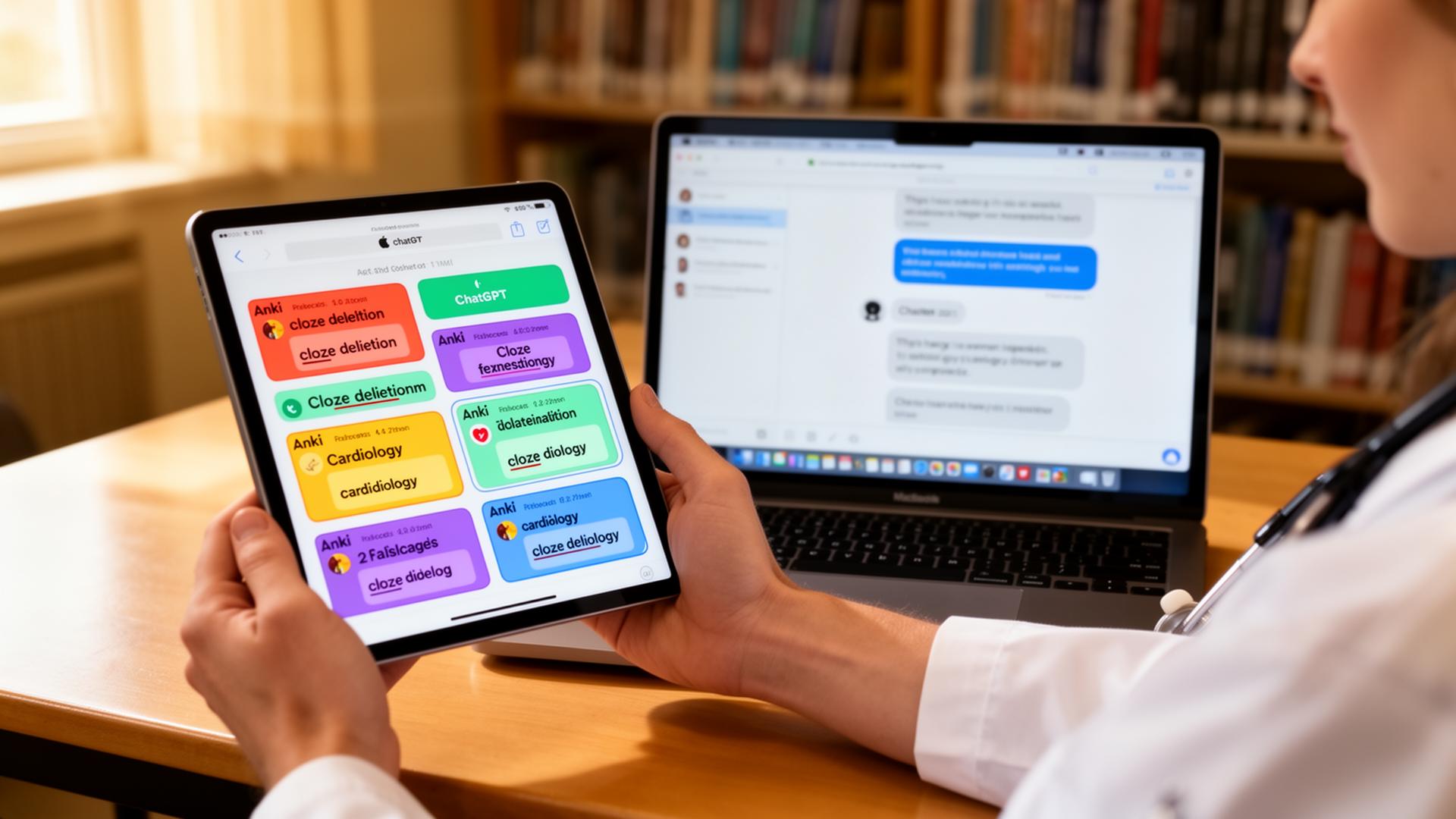
The prompt that works: 'Turn these notes into Anki cloze cards. One fact per card. No compound facts. Max 25 words. Format each as text {{c1::answer}} more text.' Paste your notes, copy the output into Anki's import function. A 90-minute lecture becomes 40 to 60 atomic cards in about three minutes. The deeper workflow is in anki-ai-workflow-for-med-school.
| Flashcard tool | Spaced repetition? | Price | Best for |
|---|---|---|---|
| Anki + ChatGPT | SM-2 (gold standard) | Free ($24.99 iOS app) | Long-term retention, exam prep |
| Knowt | Basic | Free / $9 mo | Quick auto-cards from PDFs |
| RemNote | SM-2 variant | Free / $8 mo | Note-taking and cards in one app |
| Quizlet AI | Leitner-style | $36/year | Casual study, group sharing |
Best AI for medical illustration and diagrams
Winner: Angiosome. Generic image AI is the single most dangerous category of tool a medical student can use. ChatGPT's image generation, Midjourney, Google Gemini, Stable Diffusion — every one of them will produce a brachial plexus with four roots, a heart with two left atria, or a femur with no neck, and present it confidently. The model has no concept of anatomical truth. It is matching pixels to other pixels labelled 'medical diagram' in its training data.
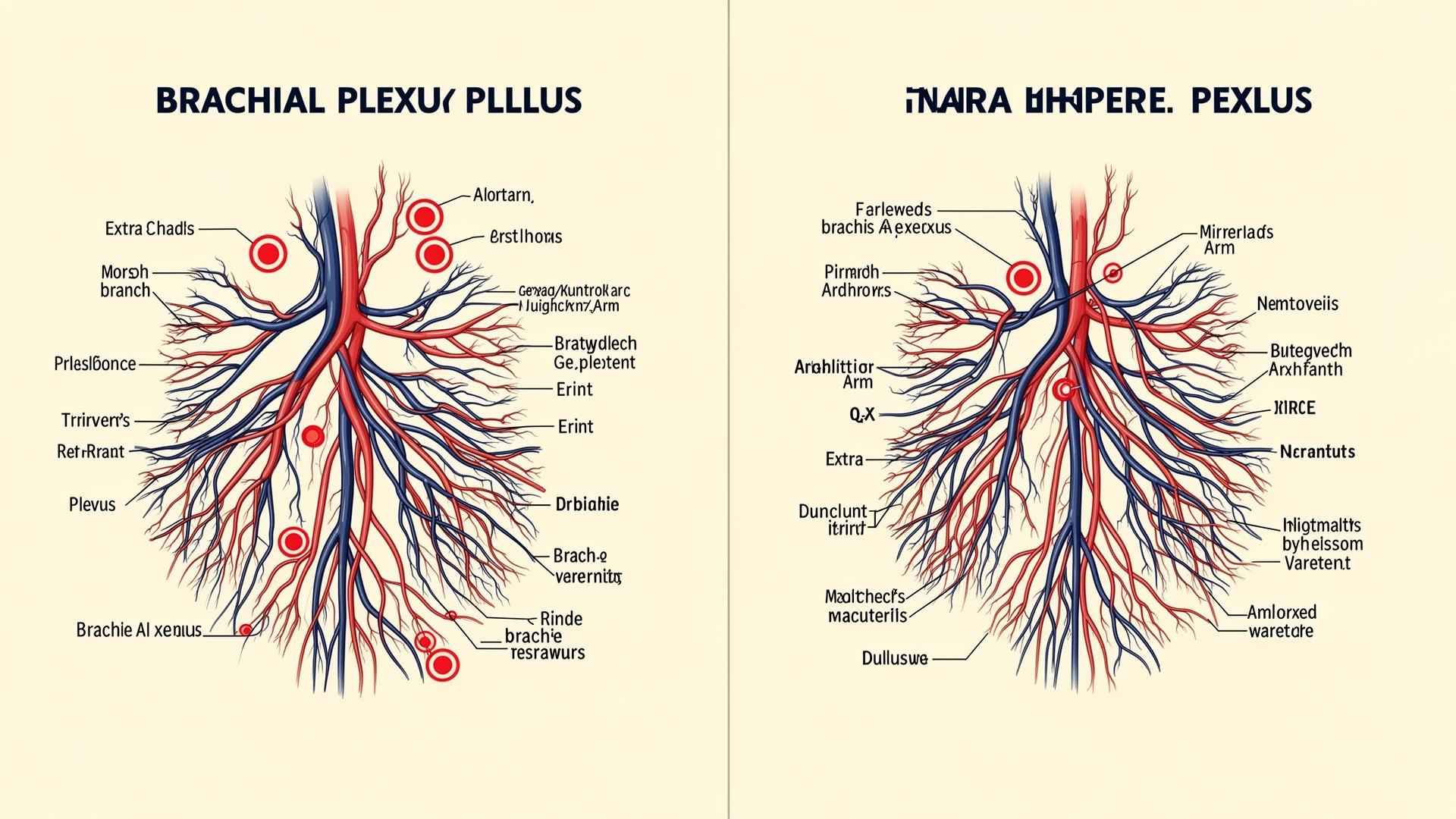
Angiosome solves this by inverting the workflow: you sketch the structure (a stick-figure-level drawing is enough), and the model only handles the rendering and labelling. The anatomy is yours; the polish is the model's. This is the only safe pattern for any diagram going into your notes or a presentation. Read ai-medical-illustration for the longer argument, or how-to-make-anatomy-diagrams-with-ai for the step-by-step.
Best AI for finding real, citable papers
Winner: Consensus (free tier generous). Runner-up: Elicit. Both search the actual scientific literature — Consensus indexes around 200 million papers from Semantic Scholar — and return real DOIs with a one-line summary of the conclusion. ChatGPT, Claude and Gemini all fabricate plausible-looking citations. This has been documented since 2023, was reconfirmed in a 2024 JAMA Network Open audit, and still happens in 2026. Never use a general chatbot to find references for an essay, audit, or portfolio.
| Citation tool | Price | Best for |
|---|---|---|
| Consensus | Free / $9 mo | Quick evidence summaries with real DOIs |
| Elicit | Free / $12 mo | Systematic-review-style workflows |
| Scite | $20/mo | Citation context — was the paper supporting or refuting? |
| Perplexity | Free | Quick web-grounded answer with sources (verify each one) |
Best AI for case-presentation slides and OSCE practice
For slides, winner: Gamma. Paste a case outline, get a deck in under a minute. The structure is good; the medical imagery is generic stock. Always replace those images with diagrams you trust — your own Angiosome renders, BMJ Best Practice screenshots, or Radiopaedia cases. Free tier gives you 400 credits, enough for around 10 decks. Full workflow in ai-presentations-for-medical-school.
For OSCE practice, winner: Claude. It is the most willing of the major chatbots to play a simulated patient who is vague, anxious, or in pain without immediately breaking character to be helpful. The prompt: 'You are a 54-year-old patient presenting with central crushing chest pain. Answer my questions briefly and vaguely. Don't volunteer information. After 8 minutes, give me feedback as the examiner.' ChatGPT works too, especially in voice mode, but tends to over-help.
- Open Claude or ChatGPT voice mode.
- Paste the case stem and the role-play instructions above.
- Run the station for the time limit (8 minutes for history, 5 for explanation).
- Ask the model to switch to examiner mode and give marked feedback against a real station rubric (paste the marking scheme if you have one).
- Repeat the same case three days later — spaced repetition works for stations too.
AI tools we don't recommend for medical school (and why)
- Generic 'AI study buddy' subscription apps that wrap GPT-4 with a nicer UI and charge $25 to $40 a month. You are paying for the wrapper; the underlying model is one you already have for free.
- AI clinical-decision tools marketed to students. The good ones are built for clinicians and assume context students don't have; the bad ones are unsafe at any level.
- AI image apps that promise 'medical illustration' but use general Stable Diffusion or Midjourney under the hood. The output looks plausible and is anatomically broken. The biorender-alternatives guide breaks down what to use instead.
- Anything that claims to 'pass your exam for you'. At best a content overlap with question-bank piracy; at worst, nonsense. Most medical schools now scan for AI-generated essays with tools like Turnitin's AI detector.
- ChatGPT for drug doses or recent NICE guideline changes. The knowledge cutoff is months behind, and the model will confidently quote an outdated number. Use the BNF or NICE directly.
The stack we'd actually pick for one medical student
Across pre-clinical and clinical years, the realistic baseline stack costs nothing. Add one paid tool only if your specialty is image-heavy.
- ChatGPT free — explanations, flashcard generation, OSCE roleplay.
- NotebookLM free — grounded answers from your own lecture material.
- Anki free ($24.99 one-off on iOS) — the only schedule that matters for long-term retention.
- Angiosome — anatomically faithful diagrams when generic AI won't do.
- Consensus free — real citations for essays and audits.
Total monthly cost: zero pounds, or one paid subscription if you're heavy on diagrams (anatomy demonstration, surgical specialty, radiology). Compare that to the £400 a year a typical 'AI medical study app' bundle costs and you have the entire argument for picking by job instead of by brand.
A note on academic integrity
Most UK and US medical schools updated their AI policies between 2023 and 2025. The consensus, summarised across the GMC's 2024 guidance and a 2024 AAMC position statement, is: using AI to explain a concept, generate flashcards, or rehearse a presentation is fine. Submitting AI-written reflective pieces or essays as your own work is misconduct. Always read your school's specific policy and, when in doubt, declare it.
Sources
- NotebookLM — official Google product page — Google
- Anki — official site and documentation — Damien Elmes
- Use of Anki flashcards by medical students — Annals of Medicine and Surgery, 2023
- Karpicke & Roediger — The Critical Importance of Retrieval for Learning — Science, 2008
- AAMC statement on generative AI in medical education — Association of American Medical Colleges
- GMC — Good medical practice (2024 update) — General Medical Council
- Consensus — AI evidence search — Consensus
- British National Formulary (BNF) — NICE
Frequently asked questions
What is the best AI tool for medical students overall?
There isn't a single best AI tool for medical students — there is a stack. ChatGPT free for explanations and flashcard generation, NotebookLM for grounded lecture summaries, Anki for spaced repetition, Angiosome for anatomy diagrams, and Consensus for real citations. Together they cost zero pounds a month and outperform any single paid 'AI medical study app' on the market.
Is ChatGPT Plus worth it for medical school in 2026?
Only if you regularly hit free-tier limits or genuinely use voice mode for OSCE practice and the built-in image generator. At £16 a month, it pays off only if you use it daily. Most medical students get through a full academic year on the free tier without noticing. Start free, upgrade only when you actually hit a wall, and cancel during exam-free months.
Which AI is most accurate for medical content?
Claude tends to be the most cautious and least likely to fabricate, followed by ChatGPT and Gemini. None of the general models are reliable for drug doses, recent guideline updates, or fine anatomical detail. Always verify those against the BNF, NICE, UpToDate, or a current textbook. For citations, use Consensus or Elicit because all general chatbots still invent plausible-looking DOIs in 2026.
Is there a free AI tool that summarises medical lectures?
Yes. NotebookLM is free with a Google account, accepts up to 50 sources per notebook (PDFs, slides, transcripts), and generates study guides, FAQs and audio overviews grounded only in your uploaded material. Unlike ChatGPT, it cites every claim back to the source page, which makes it the only safe way to ask AI questions about your own lectures.
Can I use AI tools during clinical placements?
Patient-facing tools — recording, transcription, AI scribes — are governed by your hospital's information governance policy and almost always require explicit patient consent or are outright restricted. Personal study tools used outside clinical time are fine. When in doubt, ask your supervisor before using anything that touches patient data, and never paste identifiable patient information into a public AI model.
Is using AI for medical school essays considered cheating?
It depends on your school. Using AI to explain a concept, brainstorm structure, or proofread is fine almost everywhere. Submitting AI-written essays as your own work is misconduct under both GMC 2024 guidance and the AAMC's 2024 position statement, and most universities now run submissions through AI detectors. Always read your school's specific AI policy and declare any use that goes beyond proofreading.
What is the best AI tool for anatomy diagrams?
A sketch-first medical illustration tool — Angiosome and a small number of competitors. Generic image models like Midjourney, DALL-E and Google Gemini hallucinate anatomy because they generate from a text prompt with no concept of structure. Sketch-first tools take a rough drawing from you, so the topology is correct, then render and label it. The how-to-make-anatomy-diagrams-with-ai guide has the full workflow.
Can AI replace going to medical school lectures?
Not yet. AI can summarise a lecture, generate flashcards from it, and re-explain anything you didn't understand, but it can't replicate the small-group context, the lecturer's clinical anecdotes, or the social pressure of being there. The realistic use of AI is to compress post-lecture revision from four hours to ninety minutes, not to skip lectures entirely. Attend, record (with permission), then run the recording through NotebookLM.
Try it
Sketch it. Angiosome renders it.
Angiosome turns rough medical sketches into clean, labelled, photoreal diagrams — grounded in your sketch, not invented by a model. Free to try.
Open Angiosome →Keep reading
Pillar
AI for Medical Students: 2026 Playbook
Pillar
AI Medical Illustration: The Honest Guide (2026)
Tool deep-dive
ChatGPT for Medical Students: 2026 Playbook
Tool deep-dive
NotebookLM for Medical School: 2026 Guide
Tool deep-dive
Anki + AI Flashcards: Med School Workflow
Comparison
BioRender Alternatives 2026: Honest Comparison
Tool deep-dive
AI Presentations for Medical School: 2026 Guide