Tool deep-dive
Anki + AI flashcards for medical school: the workflow, prompts, and deck hygiene rules that actually work in 2026
Updated 1 June 2026 · 12 min read
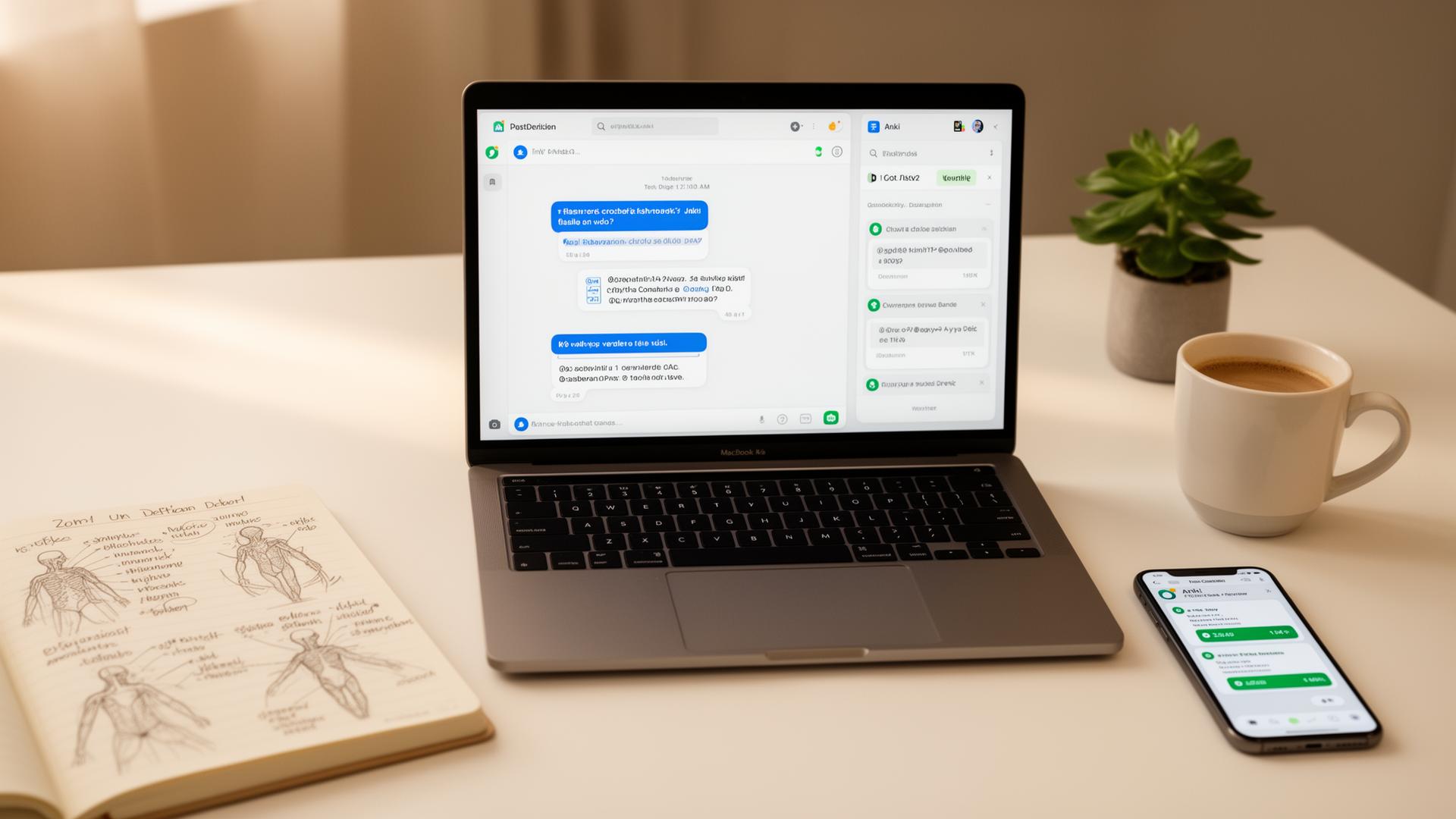
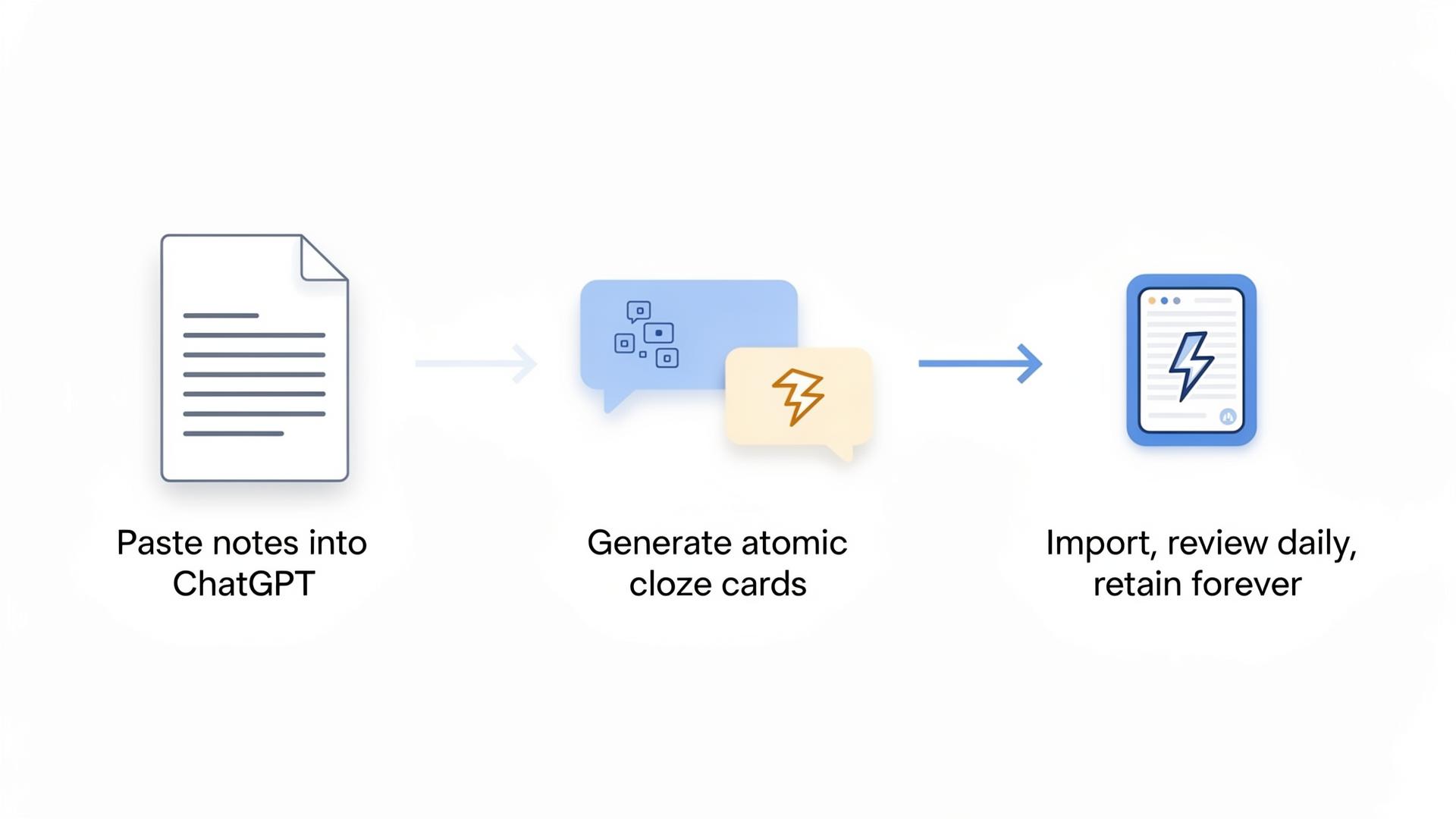
Anki + AI flashcards for medical school is the most leveraged study workflow you can run for free. Anki without AI takes hours to set up. AI flashcards without Anki get forgotten in three days. The combination turns a stack of lecture notes into a deck of atomic, scheduled, retrievable facts in under ten minutes, and the science of spaced repetition does the memorisation work for you. This guide is the complete workflow: the prompt that produces good cards, the import steps that do not break your evening, the deck hygiene rules that keep the system sustainable, and the honest comparison against slicker all-in-one apps.
Why AI plus Anki beats either tool alone
Medical school is a memory problem wrapped in a comprehension problem. You need to understand the physiology, pathology, and pharmacology, and then you need to remember it six months later in an exam. AI helps with the first part: it re-explains concepts, generates mnemonics, and turns dense paragraphs into question-and-answer pairs. But AI on its own does not solve the memory problem. A flashcard generated by ChatGPT and reviewed once is forgotten within days.
Anki solves the memory problem. Its spaced-repetition algorithm, based on the SuperMemo-2 algorithm refined over two decades, schedules each card to reappear at the exact interval where you are about to forget it. The research is robust: a 2008 randomised study by Karpicke and Roediger published in Science found that testing yourself (retrieval practice) outperforms re-reading by roughly a factor of two for long-term retention. Anki automates this testing. You stop being a card-maker and become a card-curator.
The science: why spaced repetition actually works
The forgetting curve, first described by Hermann Ebbinghaus in 1885, shows that memory decays exponentially after learning. Without review, you forget roughly 50% of new material within a day and 80% within a month. Spaced repetition interrupts this decay by presenting the material again at increasing intervals: one day, then three days, then a week, then two weeks, then a month. Each successful retrieval strengthens the memory trace and pushes the next review further into the future.
The key insight from modern research is that retrieval itself is the learning event. When you successfully recall a fact from memory, you strengthen the neural pathways involved in that recall more effectively than when you simply re-read the fact. This is why Anki's active recall format (show question, force yourself to answer, then reveal) beats passive review apps that simply show you the answer. The difficulty of retrieval is what drives learning.
| Study method | Time invested | Retention at 1 week | Retention at 1 month |
|---|---|---|---|
| Single reading | 30 minutes | ~50% | ~20% |
| Re-reading (3x) | 90 minutes | ~60% | ~35% |
| Active recall (testing) | 45 minutes | ~80% | ~65% |
| Spaced repetition (Anki) | 15 min/day ongoing | ~90% | ~85% |
The prompt that produces atomic cards
The quality of your deck depends entirely on the prompt. A vague prompt produces compound, ambiguous cards that you will fail repeatedly and eventually suspend. A strict prompt produces atomic, testable cards that stick. This is the prompt we recommend after testing across multiple medical school curricula.
"Convert the following notes into Anki cloze deletions. Rules: one fact per card. No compound facts. Use {{c1::...}} format. Do not cloze trivial words like 'the' or 'a'. Where a list has more than two items, make each item its own card. Keep every card under 25 words. Output as plain text, one card per line. Notes: [paste]"
Atomicity is the non-negotiable rule. A card that says 'The femoral nerve supplies {{c1::quadriceps}} and {{c2::sartorius}} and {{c3::pectineus}}' looks efficient and is terrible. You will memorise the order of the muscles, not the fact that the femoral nerve supplies them. Three separate cards beat it every time. Tell the model that explicitly, and review the first ten cards manually to catch any compound facts the model missed.
| Card type | Example (bad) | Example (good) | Why the good version wins |
|---|---|---|---|
| Compound fact | ACE inhibitors cause {{c1::dry cough}} and {{c2::hyperkalaemia}} | ACE inhibitors most commonly cause {{c1::dry cough}} | One fact per card; test each side effect separately |
| List cramming | Cranial nerves: {{c1::I olfactory}}, {{c2::II optic}}... | Cranial nerve {{c1::II}} is the {{c2::optic}} nerve | Lists test order, not knowledge |
| Vague cloze | The {{c1::liver}} is important for metabolism | The liver converts ammonia to {{c1::urea}} via the {{c2::urea cycle}} | Specific, testable fact |
| Trivial cloze | {{c1::The}} femoral nerve supplies the thigh | The femoral nerve supplies the {{c1::anterior compartment}} of the thigh | Tests anatomy, not grammar |
Importing into Anki without losing your evening
The import step is where most students give up. Anki's import interface is functional but not friendly. Follow these steps exactly and the process takes under two minutes per batch.
- Copy the model's output into a plain text file. Each card should be on its own line with the cloze format intact.
- In Anki, go to File → Import. Select your text file.
- Set the note type to 'Cloze'. This is critical: importing as Basic will break the {{c1::...}} syntax.
- Set the field mapping: the entire card text goes into the 'Text' field. Leave other fields empty for now.
- Set the deck to your target module deck (e.g. 'Medicine::Cardiology::Pharmacology').
- Tag the import with the source and date (e.g. 'source:lecture-week-3 date:2026-01-15'). This makes future updates findable.
- Click Import. Anki will report how many cards were created.
- Review the first ten cards manually. Suspend any that compound facts, are too long, or test trivial information.
- Start your daily review. New cards appear mixed with due cards based on Anki's algorithm.
If you import regularly, consider creating a dedicated 'Import' deck and moving reviewed cards to their permanent homes after a week. This keeps your module decks clean and prevents accidentally importing duplicates.
Deck hygiene: four rules for a sustainable system
A deck that grows without discipline becomes unreviewable. These four rules, learned from medical students who have maintained 5,000+ card decks through finals, keep the system from collapsing under its own weight.
- One deck per discipline, not one deck per session. Create top-level decks for broad areas: Medicine, Surgery, Paediatrics, Psychiatry. Use sub-decks for modules or rotations. Daily sub-decks create fragmentation and make it hard to see your total review load.
- Suspend, don't delete. If a card is wrong, outdated, or poorly written, suspend it rather than deleting it. Suspended cards are hidden from review but remain in the database. You can review suspended cards later to see what you used to think was important, and you can reactivate them if a guideline changes back.
- Tag every import with source and date. When the BNF updates a drug recommendation or your lecturer corrects a slide, you can find every affected card in seconds using Anki's tag search. Untagged cards are needles in a haystack.
- Review daily, not in batches. Anki's algorithm assumes daily review. If you skip three days and then cram, every card that was due during those days reappears as if it were new, destroying the spacing advantage. Ten minutes every day beats two hours every weekend.
AI flashcard apps vs ChatGPT plus Anki
A growing number of apps promise to replace the ChatGPT-to-Anki pipeline with an all-in-one experience. Knowt, Quizlet's AI features, and several medical-specific apps generate cards from notes and offer their own review systems. They are slicker and faster to set up. They are also, for most students, less effective for long-term retention.
The reason is the scheduling algorithm. Anki's SuperMemo-2 implementation has been refined by millions of users over two decades. It handles leeches (cards you repeatedly fail), adjusts intervals based on your actual performance, and has a mature ecosystem of add-ons for image occlusion, statistics, and custom card types. Newer apps optimise for first-use delight, not year-two retention.
| Approach | Setup time | Daily friction | Long-term retention | Cost (2026) |
|---|---|---|---|---|
| ChatGPT + Anki | 10 minutes | Medium: separate apps | Best (mature SM-2 algorithm) | Free |
| Knowt AI cards | 2 minutes | Low: single app | Good (simpler algorithm) | Free / £5/month premium |
| Quizlet AI | 2 minutes | Low: single app | Good (pattern-matching spaced) | Free / £6/month Plus |
| AnKing premade + ChatGPT for gaps | 2–4 hours initial | Low: deck is ready | Best (peer-reviewed cards + AI gaps) | Free + optional £25/year subscription |
| Medical-specific AI apps | 5 minutes | Low: tailored interface | Variable (newer algorithms) | £10–£30/month |
The honest verdict: if you value long-term retention over setup convenience, the ChatGPT-to-Anki pipeline wins. If you value convenience and will review consistently regardless of the app, the all-in-one tools are fine. The best approach for most students is AnKing for the core curriculum plus ChatGPT for the gaps your specific course covers that the deck does not.
Two advanced adaptations worth knowing
Image-occlusion cards from AI-generated diagrams
Anatomy, radiology, and dermatology benefit enormously from image-based cards. Anki's image-occlusion add-on lets you hide labels on a diagram and test yourself on naming the structures. The workflow is simple: generate a labelled diagram using a sketch-first tool like Angiosome (see how-to-make-anatomy-diagrams-with-ai), drop the image into the image-occlusion add-on, select the labels you want to hide, and Anki generates a card for each hidden label.
This combines visual learning with spaced repetition. Instead of memorising 'the femoral nerve supplies the anterior compartment' as text, you see the diagram, occlude the label, and must recall the structure from its visual position. The retention is higher because you are encoding spatial as well as verbal memory. This is particularly powerful for neuroanatomy, where three-dimensional relationships are everything.
Audio cards from lecture transcripts
For auditory learners, run a lecture transcript through NotebookLM (see notebooklm-for-medical-school) to extract the highest-yield facts, then convert those facts into cloze cards. Tag each card with the lecture date and timestamp. When a card trips you up during review, the tag lets you jump back to the exact moment in the lecture recording where the concept was explained.
This closes the loop between passive learning (lecture) and active recall (Anki). The card reminds you that you once understood the concept; the timestamp lets you re-learn it from the original source. Over time, you need the timestamps less and less as the cards themselves become your primary source.
How much should you actually make?
The most common mistake is generating too many cards. A deck of 10,000 cards that you never finish reviewing is less useful than a deck of 500 cards that you review every day. The sustainable rate for most students is 20–40 new cards per day across all decks. This keeps daily reviews under 100 cards, which takes 15–20 minutes.
Generate more than you keep. Run the prompt, get fifty cards, import them, then suspend the ones that are too easy, too hard, or poorly written. Curate ruthlessly. The point of AI-generated cards is not to make a bigger deck. It is to make a deck small enough to actually finish each day.
| Student type | New cards per day | Daily review time | Deck size after 1 year |
|---|---|---|---|
| Light (pre-clinical, broad coverage) | 20 cards | 10–15 minutes | ~3,000 cards |
| Standard (clinical years, core modules) | 30 cards | 15–20 minutes | ~5,000 cards |
| Heavy (finals prep, gap-filling) | 40 cards | 20–30 minutes | ~7,000 cards |
| Intensive (resit, targeted weak areas) | 50 cards | 30–40 minutes | ~9,000 cards |
Safety: what to do when the model gets a card wrong
ChatGPT is not a medical textbook. It will occasionally generate cards that are wrong, outdated, or misleading. The most dangerous cards are the ones that are almost right: a drug side effect that is real but rare, a contraindication that applies to a different drug in the same class, a guideline that changed in 2024 but the model's training data ends in 2023.
The defence is verification. For every card that involves a drug, dose, contraindication, or guideline, cross-check against the BNF, NICE, or your local formulary before importing. For anatomy cards, compare against Gray's Anatomy or Radiopaedia. For biochemistry and physiology, check against your course textbook. Do not trust a card because it came from an AI. Trust it because you verified it.
When you find a wrong card, do not just suspend it. Add a tag ('verified:wrong') and note the correction in the card's extra field. This builds a personal errata list that you can share with study groups or reference when the model generates a similar card in the future.
What to read next
If you want the seven ChatGPT prompts that work for explanations and OSCE practice, read the chatgpt-for-medical-students guide. If you want to understand why sketch-first tools matter for anatomy diagrams that become image-occlusion cards, the ai-medical-illustration pillar has the full explanation. For grounded lecture summaries that feed into this flashcard pipeline, the notebooklm-for-medical-school guide has the specific setup. For the ranked tool list with prices and trade-offs, the best-AI-tools-for-medical-school guide covers the full stack.
Sources
- Karpicke & Roediger — The Critical Importance of Retrieval for Learning — Science, 2008
- Dunlosky et al. — Improving Students' Learning With Effective Learning Techniques — Psychological Science in the Public Interest, 2013
- Anki — official documentation and spaced repetition algorithm — Damien Elmes
- British National Formulary (BNF) — NICE
- Gray's Anatomy — 42nd Edition — Elsevier
- Radiopaedia — free radiology and anatomy reference — Radiopaedia.org
- AnKing — medical school flashcard deck — AnKing
- NotebookLM — official Google product page — Google
Frequently asked questions
What is the best AI flashcard generator for medical students?
ChatGPT (free tier) for writing cards and Anki (free on desktop and Android) for scheduling reviews. This combination beats every all-in-one app on long-term retention because Anki's SuperMemo-2 algorithm is more mature than the scheduling in newer tools. Knowt and Quizlet's AI features are slicker to set up but their retention is not as strong for year-long medical school curricula.
How do I make AI generate good Anki cards?
Use a strict prompt with explicit rules: one fact per card, no compound facts, cloze format with {{c1::...}}, no trivial clozes, lists split into separate cards, and every card under 25 words. Then manually review the first ten cards from each batch before importing. The prompt matters more than the model: GPT-4o-class and Claude both produce good cards with the right instructions.
Is AnKing still worth using in 2026?
Yes, for students in curricula that AnKing covers. It is a peer-reviewed, community-maintained deck of roughly 30,000 cards covering core medical school content. Use AnKing for the foundation and the ChatGPT-to-Anki workflow to fill the gaps: topics your specific course covers that AnKing does not, or updated guidelines that have changed since the deck was last revised.
Can AI replace spaced repetition?
No. AI writes cards; spaced repetition is what stops you forgetting them. They solve different problems. A card written by AI and reviewed once is forgotten within days. A card written by AI and scheduled by Anki is retained for months or years. The 2008 Karpicke and Roediger study in Science found retrieval practice outperforms re-reading by roughly a factor of two.
How many AI-generated Anki cards should I make per day?
A sustainable rate is 20–40 new cards per day across all decks, which keeps daily reviews under 100 cards and takes 15–20 minutes. Generate more than you keep and curate ruthlessly: suspend cards that are too easy, too hard, or poorly written. A smaller deck you finish daily beats a larger deck you abandon.
Are AI-generated flashcards safe to use for exams?
Only if you verify them. Cross-check every card involving drugs, doses, contraindications, or guidelines against the BNF, NICE, or your local formulary before importing. For anatomy, compare against Gray's Anatomy or Radiopaedia. The model is a card writer, not a fact checker. Verification is your job.
What should I do when I find a wrong card?
Suspend it immediately so it stops appearing in reviews. Add a tag like 'verified:wrong' and note the correction in the card's extra field. This builds a personal errata list. If the card came from a specific source (a lecture PDF, a textbook chapter), check the original source to see if the error was in your notes or the model's interpretation.
Can I use this workflow for clinical placement notes?
Yes, and it is particularly valuable for placement because your notes are often handwritten, scattered, and never reviewed. Type or dictate your key learning points each evening, run them through the prompt, and import to a dedicated placement deck. The daily review keeps placement learning from evaporating. Just never upload identifiable patient information.
Try it
Sketch it. Angiosome renders it.
Angiosome turns rough medical sketches into clean, labelled, photoreal diagrams — grounded in your sketch, not invented by a model. Free to try.
Open Angiosome →Keep reading
Pillar
AI for Medical Students: 2026 Playbook
Pillar
Best AI Tools for Medical School (2026, Ranked)
Tool deep-dive
ChatGPT for Medical Students: 2026 Playbook
How-to
How to Make Flashcards with AI (Medical Edition)
Tool deep-dive
NotebookLM for Medical School: 2026 Guide
How-to
How to Make Anatomy Diagrams with AI (2026)