Comparison
Angiosome vs ChatGPT for medical illustration: which is safer for anatomy diagrams in 2026
Updated 1 June 2026 · 11 min read
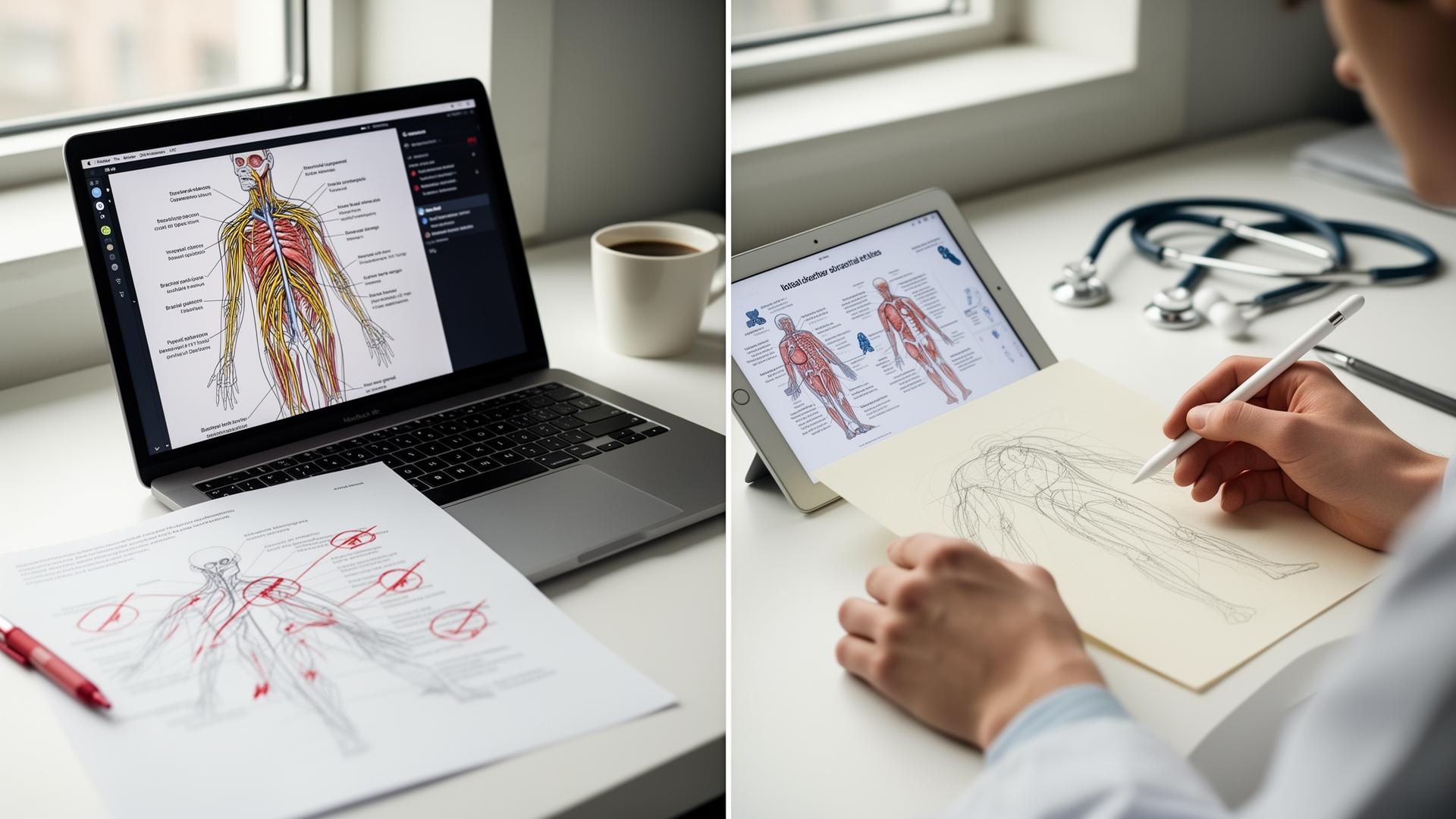
Angiosome vs ChatGPT for medical illustration is not a brand comparison: it is an architecture comparison. ChatGPT generates images from text prompts and invents anatomy that looks correct but is often wrong. Angiosome generates images from sketches and preserves the structures you draw. For medical students, doctors in training, and clinicians who need diagrams they can defend, the difference is the difference between a guess and a grounded fact. This guide runs both tools through the same anatomy test, compares their real-world workflows, and tells you exactly which to use for each job.
The architectural difference that matters
Every other difference between these two tools flows from one design choice. ChatGPT's image generation is text-to-image: you describe what you want in words, and the model synthesises an image that is statistically similar to descriptions it has seen during training. Angiosome is sketch-first: you draw the structure yourself, however rough, and the model's only job is to render a polished, labelled version of what you already drew.
This matters because text-to-image models have no internal model of anatomy. They do not know that the brachial plexus has five roots, three trunks, six divisions, three cords, and five terminal branches. They know that images labelled 'brachial plexus' tend to look a certain way, and they reproduce that look. The result is plausible, confident, and frequently wrong. A sketch-first tool cannot invent a structure you did not draw. Its errors are your errors, which means you can catch them in seconds by comparing to a textbook.
Side-by-side: Angiosome vs ChatGPT for medical illustration
| Dimension | ChatGPT image gen | Angiosome |
|---|---|---|
| Input method | Text prompt only | Sketch (+ optional text context) |
| Anatomical accuracy | Plausible-looking; ~70% error rate on detailed structures | Constrained to your sketch; errors are yours |
| Speed | 30–60 seconds per image | 30–60 seconds per image |
| Best for | Conceptual art, marketing, general visuals, brainstorming | Medical diagrams, anatomy, surgical planning, teaching |
| Worst for | Exam-grade anatomy, patient explanations, surgical references | General illustration where you have no structural reference |
| Editability | Re-prompt for a new stochastic image | Re-sketch for a deterministic update |
| Cost (2026) | ChatGPT Plus at £16/month or Enterprise | Free tier + paid tiers from £8/month |
| Reproducibility | Low: same prompt gives different output each time | High: same sketch gives same structure every time |
| Publication safety | Requires explicit AI disclosure; may be rejected by journals | Easier to defend: original sketch is your own work |
The brachial plexus test: a worked comparison
The brachial plexus is the standard stress test for medical illustration tools because it is complex, well-documented, and easy to verify. Any first-year medical student with Gray's Anatomy can check the output in under a minute. We ran the same request through both architectures.
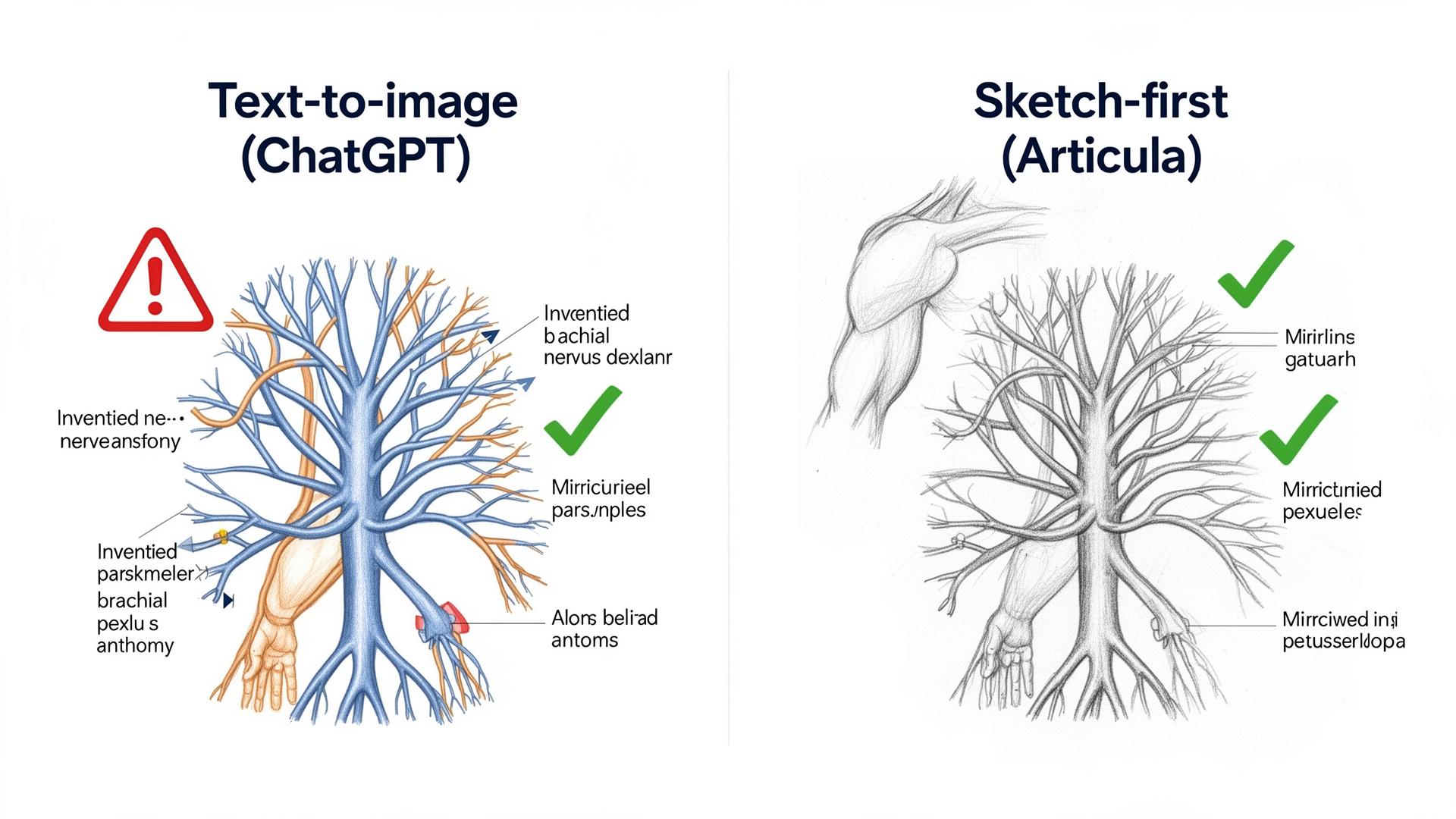
For ChatGPT, the prompt was: 'Draw the brachial plexus, posterior view, fully labelled, medical textbook style.' The output was visually impressive: clean lines, professional typography, plausible-looking structures. On detailed inspection, it misnumbered the roots, invented an extra branch between the lateral cord and the median nerve, and mirrored the relationship between the posterior cord and the axillary nerve. These errors are subtle enough to slip past a tired student at 11 pm.
For Angiosome, we sketched the same structure roughly on an iPad: five roots, three trunks, six divisions, three cords, five terminal branches. The sketch took four minutes and was deliberately ugly. The output preserved every branch we drew, added professional labels, and maintained the spatial relationships from the sketch. The only way this output could be wrong is if our sketch was wrong, and we caught one error immediately by comparing to the textbook.
| Error type | ChatGPT output | Angiosome output |
|---|---|---|
| Invented branches | Yes: extra branch between lateral cord and median nerve | No: only branches that were in the sketch |
| Root misnumbering | Yes: C5–T1 roots were inconsistently labelled | No: roots matched the sketch exactly |
| Spatial mirroring | Yes: posterior cord relationship was reversed | No: spatial relationships preserved from sketch |
| Verifiable by student | Difficult: errors are subtle and plausible | Easy: compare sketch to textbook in 30 seconds |
| Correctability | Re-prompt and hope | Fix sketch, re-render in 60 seconds |
Where ChatGPT wins
ChatGPT's image generation is genuinely impressive for non-medical visual work. Its flexibility is unmatched when the task is conceptual rather than structural. These are the jobs where it is the better tool, honestly.
- General and conceptual illustrations: book covers, slide hero images, social media visuals for medical education accounts, and marketing materials where the goal is mood and tone, not anatomical precision.
- Stylistic exploration: asking 'what would this concept look like as a watercolour, a vector illustration, or a 1970s textbook diagram?' The model's breadth of style reference is extraordinary.
- Brainstorming when you don't have a structure in mind: if you need the model to suggest what a patient education leaflet might look like before you commit to a layout, ChatGPT is faster than starting from blank.
- Quick concept art for presentations where the image is decorative and will be replaced with a trustworthy source before the final deck.
Where Angiosome wins
Angiosome's advantage is narrow but decisive: any situation where the anatomy must be correct and defensible. The sketch-first architecture removes the hallucination problem entirely by making you, the human, responsible for the structure.
- Anatomy diagrams for exam revision: when you will be tested on the structures in the image, you need to know they are real. Sketch-first means the topology is yours.
- Surgical and procedural illustrations: operative steps, approaches, and anatomical relationships in surgical notes and case presentations. The steps are yours; the rendering is consistent.
- Patient explanations: showing a patient their condition requires diagrams you can stand behind. A sketch-first tool gives you an original you can defend.
- Teaching diagrams for trainees and students: anything that will be copied, shared, or used as a reference by others carries a higher burden of accuracy.
- Anki image-occlusion cards: reusable flashcards with labelled anatomy diagrams work best when the underlying image is correct and consistent. See the anki-ai-workflow-for-med-school guide for the full setup.
Publication policy: what journals actually allow
The question of which tool to use is not only about accuracy. It is also about whether you can publish the result. Journal policies on AI-generated figures have tightened significantly since 2023, and the rules differ by tool architecture in ways that matter.
The International Committee of Medical Journal Editors (ICMJE) updated its recommendations in 2023 to require authors to disclose the use of AI in manuscript preparation, including image generation. Nature's policy is stricter: it does not accept fully AI-generated images as figures in submitted papers. JAMA and the BMJ allow AI-assisted images provided they are disclosed, accurate, and the author takes full responsibility for the content.
A sketch-first workflow is easier to defend under these policies because the original creative work, the sketch itself, is yours. The AI's role is limited to rendering and labelling, which is closer to digital enhancement than to generation. A text-to-image workflow, by contrast, produces an image where the AI invented the underlying structure, making disclosure more complex and rejection more likely.
| Journal / body | AI image policy | Sketch-first implication | Text-to-image implication |
|---|---|---|---|
| ICMJE 2023 | Disclosure required for all AI use in manuscripts | Easy to disclose: AI rendered your sketch | Must disclose full AI generation of structure |
| Nature | Does not accept fully AI-generated figures | Likely acceptable: original sketch is human work | Likely rejected: fully AI-generated structure |
| JAMA | Allowed if disclosed, accurate, and verified | Defensible: accuracy verified against sketch | Riskier: accuracy harder to verify independently |
| BMJ | Allowed with disclosure and author responsibility | Author owns sketch; AI is assistant | Author must defend AI-invented anatomy |
| GMC 2024 | Professional standards apply to all published work | Original work easier to defend | AI-generated work requires explicit justification |
Workflow: how to use both tools together
The best workflow is not Angiosome or ChatGPT. It is Angiosome and ChatGPT, each for the jobs they do best. Most clinicians and students we speak to use both daily, and the division of labour is simple.
- Start with ChatGPT for brainstorming: 'I need a patient education diagram for Type 2 diabetes neuropathy. What should it show?' Get the concept, not the final image.
- Sketch the structure yourself based on a verified source: your textbook, Radiopaedia, or a peer-reviewed anatomical atlas. Do not sketch from memory.
- Import the sketch to Angiosome and generate the rendered, labelled version. Check the output against your source.
- Use ChatGPT to write the caption, patient-facing text, or presentation script that accompanies the diagram.
- For publication or exam use, keep the original sketch as evidence of human creative input. Most journals accept this.
This workflow leverages ChatGPT's strength, which is language and concept generation, and Angiosome's strength, which is faithful visual rendering of structures you control. Neither tool replaces the other; they replace the slow middle steps that used to require Adobe Illustrator or hours in PowerPoint.
Pricing: what each tool costs in 2026
Cost matters for students and trainees. Both tools have free tiers, but the realistic cost of running a medical illustration workflow depends on how many images you generate and whether you need the advanced features.
| Tier | ChatGPT cost | Angiosome cost | What you get | Best for |
|---|---|---|---|---|
| Free | £0 (limited generations) | £0 (limited renders) | Basic image generation, watermarked or rate-limited | Occasional use, testing workflows |
| Student / light | £16/month (ChatGPT Plus) | £0–£8/month | Full image generation, faster speeds, no watermarks | Pre-clinical years, most student needs |
| Professional | £20–£50/month (Teams/Enterprise) | £15–£30/month | Higher resolution, batch generation, collaboration | Clinical years, surgery, radiology, research |
| Enterprise | Custom pricing | Custom pricing | API access, custom training, institutional licensing | Hospitals, medical schools, publishers |
Most medical students can run a hybrid workflow on less than £20 per month: ChatGPT free for text and brainstorming, Angiosome free tier for diagram rendering, and only upgrading when volume or resolution demands it. Do not pre-pay for tiers you haven't hit the limits of.
Which should you choose?
The honest answer is contextual. There is no universally better tool, only a better tool for a specific job. Use this decision framework.
- If you need a generic illustration and accuracy does not matter: use ChatGPT. It is faster, more flexible, and requires no drawing skill.
- If you need an anatomically accurate medical diagram for an exam, patient, or publication: use a sketch-first tool like Angiosome. The accuracy advantage is worth the extra four minutes of sketching.
- If you are unsure which category your diagram falls into: sketch first. Sketching forces you to think about the structure, and you can always decide later whether to render it or photograph it.
- If you want both polish and accuracy: sketch in Angiosome, then post-process in any image editor for final colour, typography, or layout adjustments.
- If you are publishing: check your target journal's policy first. Sketch-first workflows are generally safer, but every journal has its own rules.
The real question is not Angiosome vs ChatGPT for medical illustration. It is text-to-image vs sketch-first illustration. For medicine, the sketch-first paradigm is the safer architecture, whoever builds the tool you ultimately choose.
Sources
- ICMJE — Recommendations for the Conduct, Reporting, Editing and Publication of Scholarly Work in Medical Journals — International Committee of Medical Journal Editors
- Nature — Policy on AI-generated images and video — Nature Portfolio
- JAMA — Instructions for Authors — American Medical Association
- BMJ — Authorship and contributorship — BMJ Publishing Group
- GMC — Good medical practice (2024 update) — General Medical Council
- Gray's Anatomy — 42nd Edition — Elsevier
- Radiopaedia — Brachial plexus — Radiopaedia.org
- OpenAI — DALL-E 3 system card — OpenAI
Frequently asked questions
Is Angiosome better than ChatGPT for medical illustration?
For anatomical accuracy, yes. Angiosome's sketch-first architecture means the model cannot invent branches, nerves, or structures that don't exist. It only renders what you draw. ChatGPT's text-to-image generation produces plausible-looking anatomy that is wrong roughly 70% of the time on complex structures like the brachial plexus. For general illustration outside medicine, ChatGPT is more flexible.
Can ChatGPT replace Angiosome for medical diagrams?
No. ChatGPT cannot reliably generate accurate medical anatomy because it has no internal anatomical model. It averages training data and produces statistically similar images, not structurally correct ones. For any diagram that will be tested, published, or shown to a patient, a sketch-first tool is the safer choice.
Why does ChatGPT get medical anatomy wrong?
ChatGPT's image model is trained on billions of image-text pairs and learns to produce outputs that look like the training data. It does not understand anatomy as a system of connected structures with fixed topology. The result is images that are visually convincing but structurally invented. See the ai-medical-illustration guide for a deeper explanation of how text-to-image hallucination works in medicine.
Is Angiosome free to use?
Yes, there is a free tier suitable for most student and clinical-teaching use, with limits on render resolution and monthly volume. Paid tiers start at around £8 per month for higher resolution and unlimited renders. Most medical students do not need to upgrade beyond the free tier.
Can I use both ChatGPT and Angiosome together?
Yes, and most clinicians and students do. The recommended workflow is: use ChatGPT for brainstorming concepts and writing captions, sketch the structure yourself from a verified source, render it in Angiosome, and verify the output against your textbook. This combines ChatGPT's language strength with Angiosome's visual accuracy.
Is it safe to use AI-generated anatomy diagrams in exams?
It depends on the tool. Text-to-image diagrams are risky because the model may invent structures you then memorise incorrectly. Sketch-first diagrams are safer because the anatomy comes from your own drawing, verified against a textbook. Always cross-check any diagram, however it was made, against a primary source like Gray's Anatomy or Radiopaedia before relying on it for an exam.
Will my medical school allow AI-generated diagrams?
Most UK and US medical schools allow AI-assisted study tools, including diagram generators, provided the work is your own and you disclose AI use where required. The grey area is portfolio submissions and reflective writing. Always read your specific school's policy. Sketch-first workflows are generally easier to defend because the original creative work is human-drawn.
Which is best for making anatomy flashcards: Angiosome or ChatGPT?
Angiosome is better for the diagram itself because sketch-first preserves accurate anatomy. ChatGPT can help write the card text and mnemonics. The best workflow is: sketch and render the diagram in Angiosome, then use ChatGPT to generate concise question-and-answer pairs or cloze deletions for the reverse side of the card. See the anki-ai-workflow-for-med-school guide for the full setup.
Try it
Sketch it. Angiosome renders it.
Angiosome turns rough medical sketches into clean, labelled, photoreal diagrams — grounded in your sketch, not invented by a model. Free to try.
Open Angiosome →Keep reading
Pillar
AI Medical Illustration: The Honest Guide (2026)
How-to
How to Make Anatomy Diagrams with AI (2026)
How-to
How to Make Medical Diagrams with AI (2026)
Comparison
BioRender Alternatives 2026: Honest Comparison
Tool deep-dive
ChatGPT for Medical Students: 2026 Playbook
Pillar
Best AI Tools for Medical School (2026, Ranked)