Audience
AI for medical educators: the production-side stack for faculty, consultants, and clinical teachers in 2026
Updated 1 June 2026 · 11 min read
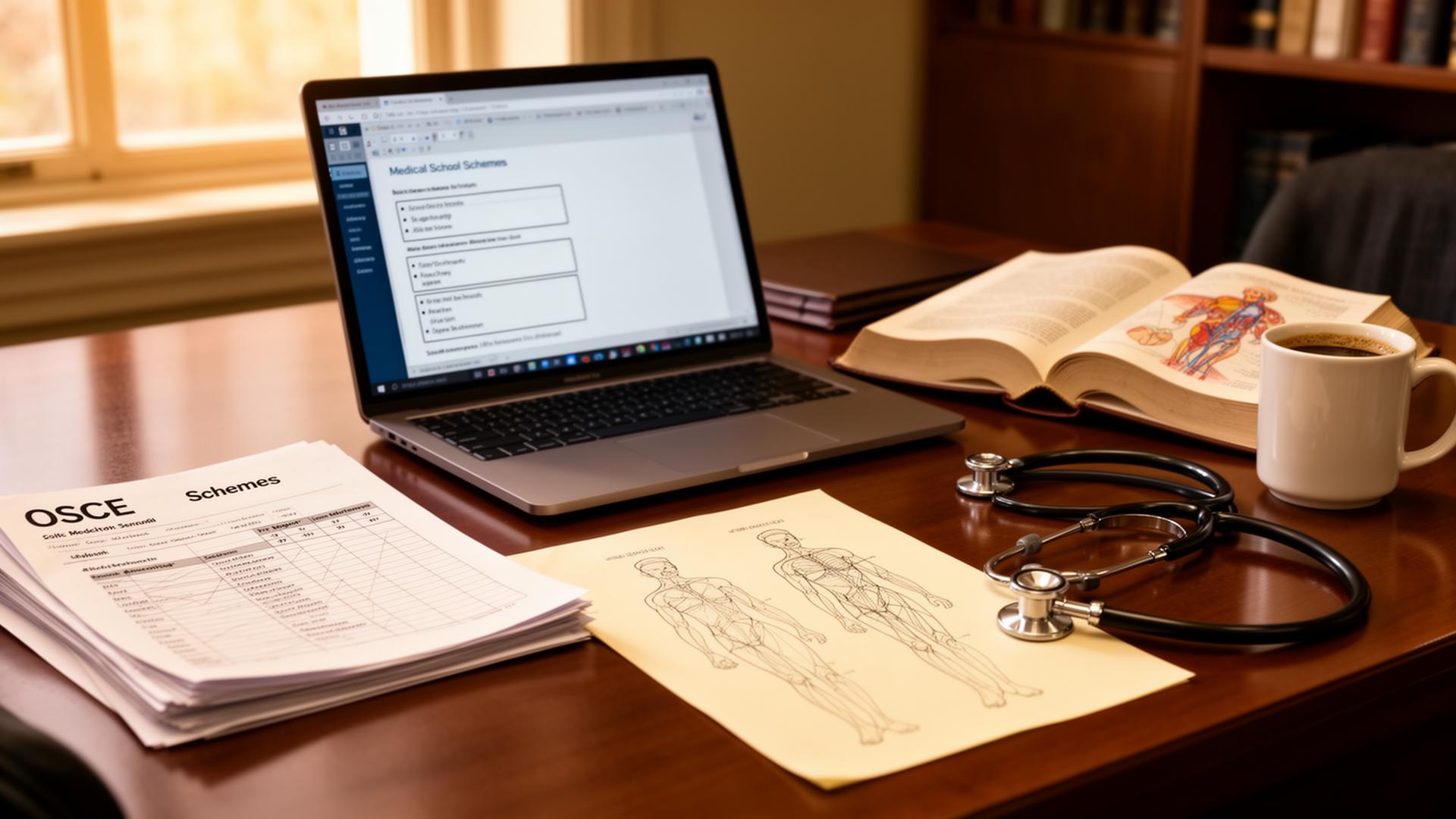
AI for medical educators is, in 2026, more useful than AI for medical students, and almost no one writes about it that way. Students need to consume material; faculty need to produce it, and AI is far better at production than comprehension. This guide is the production-side stack: which tools earn their place for slides, diagrams, SBA writing, OSCE stations, and trainee feedback, what they cost, and the GMC and institutional limits worth respecting before you use any of them with student-facing material.
How to think about AI as a clinical teacher
Medical education is a content-production problem wrapped in a curation problem. A single hour of teaching costs six to ten hours of preparation when you build from scratch, and most of that time goes into format work, not clinical thinking: laying out slides, drawing the same diagram for the third year running, writing distractors, formatting mark schemes. AI is excellent at format work and mediocre at clinical reasoning. Use it for the first, never trust it for the second without verification.
The mental model that works: AI drafts, the educator finishes. A drafted lecture deck, a drafted diagram, a drafted SBA bank, a drafted block of feedback. The clinical accuracy, the pedagogical judgement, and the trainee-specific personalisation are the parts only you can do, and those are also the parts the GMC holds you accountable for under the 2024 generative AI guidance for doctors.
The five highest-leverage uses for faculty
1. Teaching slide decks and lecture material
Gamma, Beautiful.ai, and Canva's AI presentation features turn a typed outline into a 20-slide deck in under two minutes. The structure they produce is usually serviceable. The medical imagery they generate is usually wrong: invented anatomy, mislabelled vessels, the wrong number of cranial nerves. Generate the structure, then strip out every clinical image and replace it with material you trust from Radiopaedia, BMJ Best Practice, or your own labelled diagrams. The deep workflow lives in ai-presentations-for-medical-school.
2. Original teaching diagrams
Sketch the structure, procedure, or pathology on paper or an iPad; a sketch-first tool renders it photoreal and labelled. The output is original to you (cleaner under most institutional IP policies than stock images), accurate (because you authored the topology), and reusable across slides, handouts, and exam papers without per-figure BioRender pricing. Angiosome is purpose-built for this; see ai-medical-illustration for the wider category.
3. SBA and EMQ question writing
GPT-5 and Claude Sonnet 4.5 are competent at first-draft single best answer items and distractors at preclinical level, weaker at finals-grade items where distractors need to be plausibly close. The realistic ratio is one keeper for every three drafts. Generate twenty, bin twelve, rewrite eight, ship five. You still save 60% of the time versus a blank page, and the items that survive curation are yours.
4. Feedback drafting for trainee reflections
AI can convert your bullet-point comments into structured prose feedback (strengths, areas for development, suggested actions) in seconds. Useful when you have 20 reflections to mark on a Sunday evening. Always personalise before sending: trainees can spot generic AI prose at fifty paces, and the trust cost of a flat reply is far higher than the time saved.
5. OSCE and OSCA station drafting
AI is excellent at producing station stems, mark schemes in a consistent format, and simulated-patient scripts. You curate the clinical content; the model handles the formatting and the consistent voice across a station bank. Saves a teaching half-day per station, especially when you are converting a clinical scenario you already know into examinable form.
AI tools for medical educators, by job-to-be-done
| Task | Best tool (2026) | Price | Why |
|---|---|---|---|
| Slide deck from outline | Gamma | Free tier; Pro $10/mo | Fastest outline-to-deck; export to PPTX cleanly |
| Original anatomy diagrams | Angiosome | Free tier; Pro tier paid | Sketch-first, no anatomical hallucination |
| SBA / EMQ drafting | Claude Sonnet 4.5 or GPT-5 | $20/mo each | Strongest at distractor logic and clinical reasoning |
| Lecture-grounded summaries | NotebookLM | Free | Cites the source PDFs you upload; no hallucinated references |
| OSCE station scripts | GPT-5 | $20/mo | Strong format consistency across a station bank |
| Trainee feedback drafting | ChatGPT or Claude | Free tier often enough | Bullet-to-prose conversion in seconds |
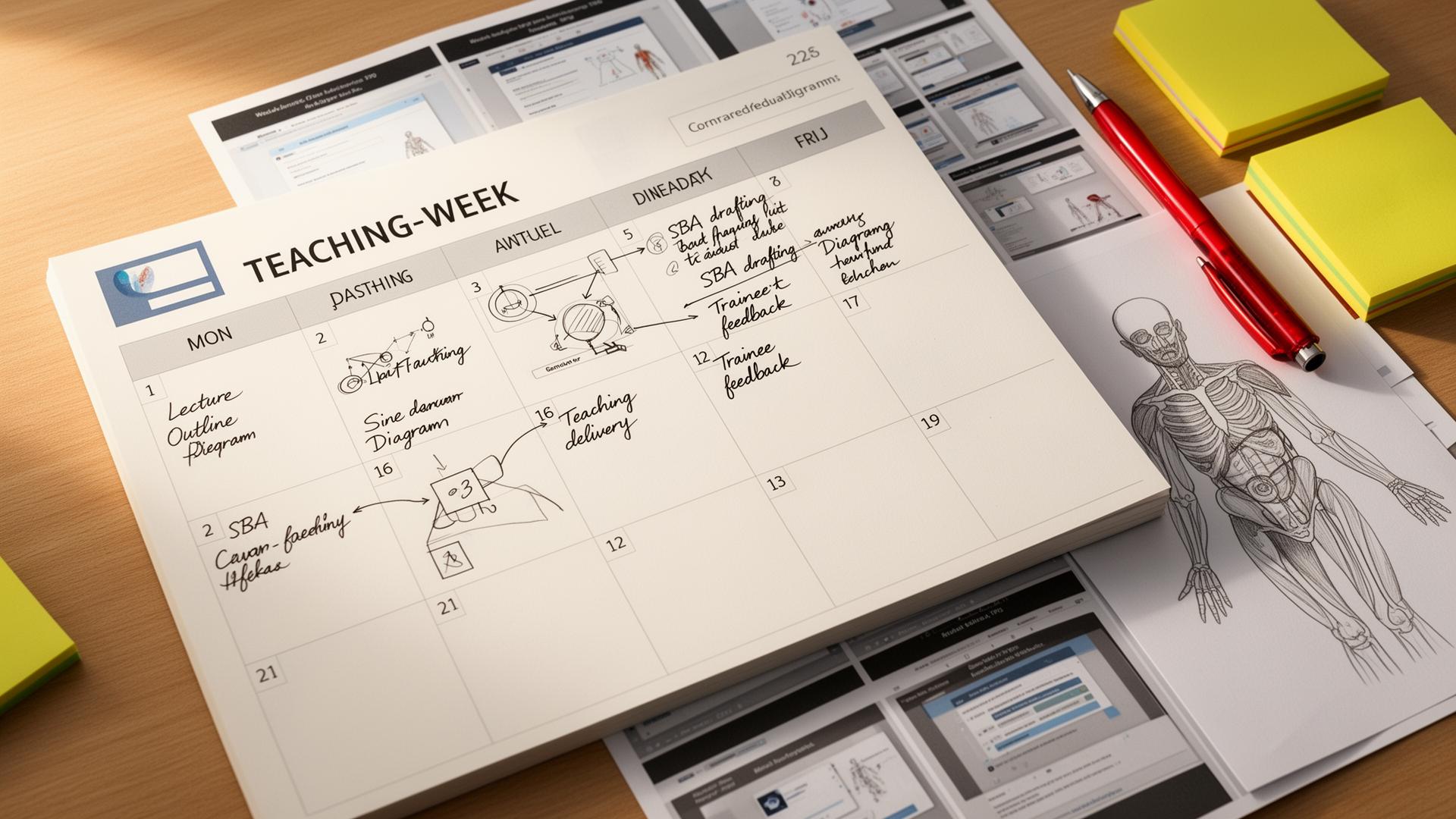
A realistic teaching-week workflow
The point of an AI workflow is not to use AI everywhere, it is to use it on the tasks where the format work dominates the thinking work. A realistic week for a consultant who teaches half a day:
- Monday: outline next week's teaching in a text doc. Drop it into Gamma; generate a first-draft deck. List the diagrams you will need.
- Tuesday (45 min): sketch each diagram on paper or iPad. Render via a sketch-first AI tool. Drop into the deck, replacing the stock medical images.
- Wednesday (60 min): draft 20 SBAs in Claude or GPT-5 against the learning objectives. Bin half, rewrite the rest.
- Thursday: deliver teaching. Capture three improvements for next round in a notes app.
- Friday (30 min): AI-draft prose feedback from your bullet comments on 15 trainee reflections. Personalise each. Send.
GMC, institutional, and data-protection limits
The GMC's 2024 guidance on generative AI for doctors is the most relevant single document for UK faculty. It does not ban AI use; it makes clear the doctor remains accountable for any output used in patient care or training, and for the confidentiality of any data uploaded. In practice that means three rules: never upload patient identifiable information into a consumer AI tool; verify every clinical claim in AI-drafted teaching material before students see it; and disclose AI assistance in resources where your institution requires it.
| Situation | Rule |
|---|---|
| Student-facing clinical content | Verify every claim; AI hallucinates plausibly |
| Trainee identifiable reflections | Anonymise before pasting into any cloud AI tool |
| Draft exam papers pre-release | Only use contracted, data-retention-off enterprise tools |
| AI-assisted marking of formal assessment | Check faculty policy and regulator stance first |
| Patient images or notes for case-based teaching | Strip identifiers; check Caldicott guardian guidance |
Prompts worth saving in your notes app
The single highest-return faculty habit in 2026 is keeping a short library of prompts that you tweak per teaching block, instead of writing each one from scratch. Five worth stealing:
- 'Generate 10 SBAs for [topic] at [year level]. One best answer, four distractors, each distractor a common clinical misconception. Include a one-sentence rationale per option.'
- 'Convert these bullet-point comments on a trainee reflection into 150 words of structured feedback: strengths, areas for development, two specific suggested actions. Comments: [paste].'
- 'Draft an OSCE station for [scenario] including: candidate instructions, simulated patient script, examiner mark scheme with clear pass criteria, total 10 minutes.'
- 'Summarise this lecture transcript into a one-page student handout: learning objectives, three key concepts, two clinical applications, five recall questions. Transcript: [paste].'
- 'Re-write this paragraph at [year level] reading age, keeping the clinical accuracy. Flag any claim you are not confident about. Paragraph: [paste].'
Modelling good AI use to your trainees
If you teach trainees, they will adopt your AI habits, your shortcuts, and your blind spots. The right defaults at faculty level shape what an entire cohort thinks AI is for. Three habits worth modelling: cite sources alongside AI-drafted summaries, show the verification step you took before trusting an AI claim, and be explicit when a slide or handout was AI-assisted. The trainees who watch a senior clinician verify and disclose AI use are the ones who become safe AI-using doctors.
The inverse is also true. A consultant who pastes patient notes into ChatGPT in front of an FY1 has just trained that FY1 to do the same thing on call, without the legal cover. The cultural transmission is faster than any e-learning module the trust will roll out.
Sources
Sources
- GMC: Good Medical Practice and generative AI (2024)
- BMJ: Generative AI in medical education (2024)
- NEJM: Benefits, Limits, and Risks of GPT-4 as an AI Chatbot for Medicine
- AMEE Guide: Artificial intelligence in medical education
- Karpicke & Roediger, Science 2008: The critical importance of retrieval for learning
- Google NotebookLM
- OpenAI: ChatGPT for education
- Caldicott Principles (UK National Data Guardian)
Frequently asked questions
What is the best AI tool for medical educators in 2026?
There is no single best AI tool for medical educators. The strongest stack is Gamma for slide decks, a sketch-first tool such as Angiosome for original medical diagrams, Claude Sonnet 4.5 or GPT-5 for SBA and OSCE drafting, and NotebookLM for source-grounded lecture summaries. Combined cost is under £50 a month per faculty member, and most have usable free tiers.
Is it safe to use AI to write medical exam questions?
For first drafts, yes, provided you treat the output as a starting point and verify every clinical claim. For final exam papers, only use AI tools where data retention is disabled and you have institutional approval. Consumer ChatGPT and Claude tiers may retain inputs by default, so any pre-release item bank uploaded to them is a potential exam-security breach.
Will AI replace medical educators?
No. AI replaces the format work in medical education (slide layout, mark scheme formatting, prose drafting), not the judgement work (clinical accuracy, curriculum design, trainee assessment, bedside teaching). The GMC's 2024 guidance is explicit that the doctor remains accountable for AI-assisted output. Faculty who use AI well will out-produce faculty who do not, but neither group is replaceable.
How is AI for medical educators different from AI for medical students?
Students mostly consume material and use AI to re-explain, summarise, and generate flashcards. Educators mostly produce material and use AI to draft slides, diagrams, questions, and feedback at scale. The toolset overlaps (ChatGPT, Claude, NotebookLM, Angiosome) but the highest-value workflows are production-side for educators and comprehension-side for students.
Can I get caught using AI to write teaching material?
Most institutions in 2026 expect AI assistance in teaching material and ask only that it be disclosed. AI detectors are unreliable for prose and almost useless for diagrams, so the practical risk is reputational, not technical. The safer route is transparent disclosure in resource credits, which sets norms for your trainees and protects you if questions arise later.
Is AI better than BioRender for teaching diagrams?
For generic cell biology and signalling pathways, BioRender's icon library is still the fastest option. For original anatomy, surgical, and procedural diagrams that need to match exactly what you teach, a sketch-first AI tool such as Angiosome is faster, cheaper at scale, and gives you images that are original to you rather than templated. Many faculty use both.
How much time does AI realistically save a teaching consultant?
Four to eight hours a week is a realistic range for a consultant who teaches half a day and supervises trainees. The biggest gains are in slide preparation (60% time reduction), diagram production (90% reduction versus illustrating from scratch), and trainee feedback drafting (75% reduction). Marking and clinical assessment design save less because verification remains slow.
What is the best AI for OSCE station writing?
GPT-5 and Claude Sonnet 4.5 both produce high-quality OSCE station drafts including candidate instructions, simulated patient scripts, and structured mark schemes. GPT-5 has a slight edge on format consistency across a station bank; Claude has a slight edge on natural simulated-patient dialogue. Either saves roughly a teaching half-day per station versus drafting from scratch.
Try it
Sketch it. Angiosome renders it.
Angiosome turns rough medical sketches into clean, labelled, photoreal diagrams — grounded in your sketch, not invented by a model. Free to try.
Open Angiosome →Keep reading
Pillar
AI for Medical Students: 2026 Playbook
Audience
AI for Residents & Registrars: 2026 Practical Guide
Pillar
AI Medical Illustration: The Honest Guide (2026)
Tool deep-dive
AI Presentations for Medical School: 2026 Guide
Pillar
Best AI Tools for Medical School (2026, Ranked)
How-to
How to Make Medical Diagrams with AI (2026)